
Executive Summary
What’s the next evolution of enterprise business applications? This paper introduces the concept of an AI-driven Unified Application User Interface (UAUI) – an idea that could reshape the landscape of ERP, HCM, SCM, and other enterprise applications.
Imagine a world where complex application functions or cross-functional tasks are executed seamlessly through a single, intuitive AI-powered interface. By transcending the traditional boundaries in individual enterprise applications as well as amongst a suite of applications, UAUI promotes the idea of an enterprise environment that elevates user productivity, accelerates decision-making and propel businesses into a new era of agility and operational excellence.
The UAUI doesn’t just bridge gaps between individual enterprise applications; it completely redefines the user experience, offering intelligent, unified interaction across the entire enterprise application ecosystem. It’s more than an interface – it provides a pathway for enterprise application vendors to completely reimagine how modern enterprise applications behave and deliver value in the future, whilst creating new product categories and revenue models.
The proposed paradigm shift is: why should a user need to understand the underlying modules, sub-modules, and workflow complexities of an enterprise application? How can enterprise applications evolve into a unified objective function – focused solely on delivering business outcomes – through a simple chat and voice driven interface powered by agentic flows?
The Challenge: Breaking Down Application Barriers
The current enterprise applications present a significant opportunity to revolutionize its design and function. Rather than users having to navigate multiple interfaces and workflows to accomplish their objectives and outcomes, the time is optimal for a complete re-imagination of how users will interact with enterprise applications.
The reason for this re-imagination is multi-fold. The current application interaction method for end-users leads to:
– Operational bottlenecks
– Inefficient and incomplete adoption due to complexities
– Decision-making delays
– Dependence on specialized knowledge/ experience to operate and interact
The big idea: what if each individual enterprise application (e.g., ERP, HCM etc) and cross-functional interactions between enterprise applications (e.g., HCM process interacting with ERP) were done via a simple unified AI interface? This simple interface bridges the above gaps by focusing on objectives and outcomes rather than individual application functions. The end user will not need to learn the systems and workflows of each enterprise application, instead, they provide objective instructions via a chat/ voice interface to achieve their business outcomes. The AI agents powering the Unified Application User Interface (UAUI) manages the underlying system interactions and workflows to deliver the end user’s intents.
The Solution: A Four-Stage Evolution
The proposed roadmap to achieve a unified AI-driven interface consists of four key stages:
1. Embedded AI in Applications: In this foundational stage, AI functionalities are integrated within specific applications to enhance features like predictive analytics, process automation, and workflow optimisation. For instance, ERP systems might incorporate AI for real-time financial forecasting, while supply chain systems could leverage AI to predict demand or identify bottlenecks (Oracle’s Fusion embedded AI features are an example of this).
2. Task-Level AI Agents: This phase introduces specialized AI agents capable of managing specifictasks within an application. For example, in an HCM system, a task-level AI agent might automate routine processes such as leave requests, payroll updates, or onboarding activities, allowing faster and more efficient operations (Oracle’s upcoming Fusion AI task agents are an example of this).
3. Application-Level AI Orchestrators: In this stage, AI orchestrators manage multiple task-specific AI agents within a given application domain (e.g., Supply Chain/ Procurement). These orchestrator AI agents enhance cross-function coordination, enabling more comprehensive services within the application context. For example, in a supply chain system, an AI orchestrator agent will synchronise inventory management, procurement, and logistics by predicting inventory shortages, automatically initiating procurement requests, and recommending product/ material prices based on market trends/ supplier options – all whilst adhering to necessary approval and checkpoint workflows. The key feature here is the ability to drive and orchestrate multiple workflows and invoke the relevant task-specific AI agents outlined in point 2 above.
4. Unified Enterprise AI Orchestrator (Unified UI): The ultimate evolution involves a Unified Application User Interface, UAUI, powered by agentic flows that transcends individual applications and manages interactions across the entire enterprise application ecosystem. Users engage with a single AI-powered user interface that handles all their tasks, retrieving and processing data across all relevant enterprise application systems. This allows users to focus on their objectives while the AI manages the complexity of the underlying applications and workflows.
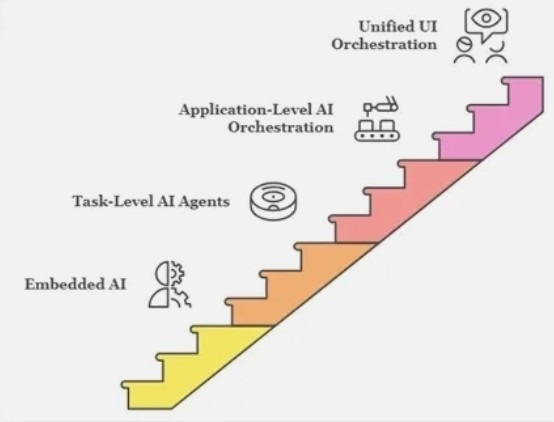
Figure: Four stages of evolution culminating in a Unified Enterprise Application UI
The Vision in Action: A Day in the Life of a CHRO
Imagine Jane, a CHRO at a global corporation, faced with a critical workforce planning decision. Using the Unified Application UI:
1. Jane initiates a simple chat instruction via the UAUI: “Analyse the impact of our proposed workforce changes to increase the head count of AI Prompt Engineers and de-prioritization of Computer Programming resources”.
2. The UAUI initiates the necessary agentic flows that will instantly retrieve and process data from multiple systems – for example:
– HCM: Current headcount, skills inventory, hiring costs
– Finance: Budget implications, severance packages, long-term financial projections
– Operations: Productivity forecasts, workflow impact assessments
3. Within minutes, Jane receives a comprehensive report highlighting:
– Financial trade-offs between hiring and layoffs
– Projected impact on workforce productivity
– Potential skill gaps and mitigation strategies
– Regulatory compliance considerations
4. Upon Jane’s approval, the UAUI AI agents:
– Updates the HCM system with new hiring targets
– Adjusts financial forecasts in real-time
– Notifies relevant department heads of impending changes
– Schedules briefings with the CEO, CFO, and COO
This seamless process, which once took weeks and involved multiple teams, is now completed in a fraction of the time with unparalleled accuracy and insight using just one simple Unified UI and underlying agentic flows.
Market Opportunities: Monetization models
The advent of UAUI (Unified Application UI) presents significant market opportunities for software vendors and service providers. By transforming the way enterprises interact with business applications, these interfaces create new value propositions that can be monetized through innovative commercial models. Below are 3 such models for explorations:
1. Add-On Product Offering: Offer the UAUI as an optional add-on – either at individual enterprise application level or multiple application level. This will generate additional revenue streams while allowing customers to adopt enhancements at their own pace.
2. Integrated Default Feature: The UAUI is developed as a roll-out feature on top of existing enterprise applications, which could be offered as a value add for multi-year contracts between the vendor and new customers; or at cost for existing customers encouraging adoption as part of the core offering.
3. Outcome-Driven Pricing: A model where customers pay based on measurable business outcomes (e.g., operational efficiency improvements or cost savings) driven by the UAUI in addition to the underlying enterprise application subscription
Conclusion: Embracing the Future of Enterprise Applications
The Unified Application UI represents more than just a technological advancement; it’s a fundamental reimagining of how businesses interact with their enterprise applications.
Enterprise application vendors that embrace this paradigm shift will find themselves at the forefront of a new era of enterprise agility, armed with unparalleled decision-making capabilities and operational efficiency.
The future of enterprise applications is not about incremental innovations in individual applications – it’s about seamless, intelligent ecosystems that adapt to user needs in real-time by removing the need for subject matter expertise and application specific expertise to achieve business outcomes.
About the Author:
Kushan Kahadugoda is a seasoned business technology leader with a passion for driving transformative change through innovation. His experience spans diverse sectors — government, non-profit, education, telecommunications, financial services, and technology — and also includes Big Four consulting experience. Currently, he serves as Consulting Practice Director for AI, Innovation, and ESG at Oracle Corporation, leading initiatives in the ANZ region to foster innovation and enterprise transformation. Kushan is also a published author of 2 books.
More details: https://www.linkedin.com/in/kkahadugoda | https://kushan.blog/about
See Kushan’s profile here.