Summary:
Fear is an inherent response to uncertainty and plays a significant role in how individuals and organisations interpret and act on data. This article examines how fear manifests in data analytics, often not as overt anxiety, but as hesitation, avoidance of inconvenient insights, or delayed decision-making when evidence challenges established views. A key finding is that fear tends to increase as risk becomes more visible through data, even while decision quality improves. The article also highlights the influence of past experiences, including previous project failures, on organisational responses to analytics. Importantly, it finds that trust in governance, processes, and expert judgement is often more decisive than technical capability in overcoming resistance. The article concludes that data analytics does not remove fear, but provides a structured approach for managing it, enabling more disciplined, accountable, and effective decision-making under uncertainty.
Fear, Uncertainty and the Discipline of Data Analytics
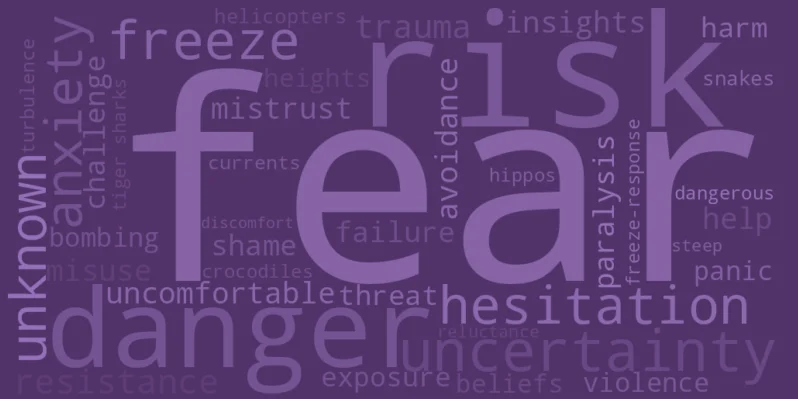
Fear is a fundamental human response that functions as a protective mechanism against real or perceived danger (Guy-Evans, 2023). It activates physiological and cognitive reactions commonly described as fight, flight, or freeze, often preceding conscious reasoning. Fear often stems from uncertainty and influenced by previous experiences, current situations, or expectations about the future. In data analytics, fear rarely presents as overt anxiety. Instead, it manifests as hesitation to act on insights, avoidance of uncomfortable findings, or paralysis when evidence challenges established beliefs or organisational narratives.
Dangerous situations I have encountered did not feel threatening at the time because I lacked critical information. In December 2003, I travelled on an overnight boat cruise along the Zambezi River (Africa), later learning that it is among the most dangerous rivers in the world. I was aware of the presence of hippos and crocodiles, yet unaware of the river’s powerful currents and the presence of tiger sharks. In August 2023, I flew into Queenstown, New Zealand, enjoying the experience without realising that I had landed at one of the world’s most challenging airports, characterised by extreme terrain and a short runway. On the way to jet skiing on the Shotover River, I also travelled along Skippers Canyon Road, often ranked among the most dangerous roads globally, without recognising the level of risk involved.
These experiences highlight a key insight for analytics practice: fear often arises not from risk itself, but from becoming aware of that risk. When the risks are unknown or poorly understood, people may feel at ease even while remaining vulnerable. When risk becomes visible through data, discomfort often increases, even as decision quality improves. Analytics therefore has a paradoxical effect: it reduces uncertainty while simultaneously heightening emotional response.
My personal fears are more explicit. I have a pronounced fear of heights, despite enjoying hiking and routinely choosing window seats on flights. While visiting the Grampians in March 2023, I froze while descending a peak and became physically unable to move. Two strangers offered help. One attempted to guide my steps verbally, while the other offered his hand. I accepted the second offer, but only after hesitation driven by mistrust and a sense of shame.
This response mirrors behaviour commonly observed in data-driven organisations. Teams may freeze when insights contradict expectations or threaten established positions. Support structures exist in the form of peer review, governance frameworks, or expert advice, yet fear often delays their acceptance. In such moments, trust becomes more influential than technical competence.
My fear of helicopters has deeper origins. As a child in late-1970s Rhodesia (now Zimbabwe) during the liberation war, helicopters and aircraft were associated with violence and bombing. That association persisted into adulthood, long after the immediate threat had passed. In analytics, similar patterns appear as organisational memory. Past project failures, poorly governed models, or misuse of data can create enduring resistance to analytical initiatives, even when conditions and capabilities have materially improved.
Even my fear of snakes, triggered by images or videos, demonstrates how emotion can override rational assessment. Data can provoke comparable reactions. Certain metrics, forecasts, or risk indicators generate anxiety disproportionate to their actual implications, yet those same indicators are often essential for sound decision-making.
Data analytics does not eliminate fear. Rather, it provides a disciplined framework for collaborating with it. Governance structures, validation processes, peer review, and transparency function as stabilising mechanisms that support judgement under uncertainty. Fear highlights situations that need closer examination, pointing out potential bias, gaps in evidence, and topics needing more thorough analysis.
When used constructively, fear becomes a diagnostic input rather than an impediment. It encourages preparation, accountability, and intellectual humility. From this perspective, fear and data analytics are in alignment. Both demand attentiveness, rigour, and the willingness to confront uncomfortable truths before progress can occur.
Reference
Guy-Evans, O. (2023, July 20). The psychology of fear: Definition, symptoms, traits, causes, treatment. Simply Psychology. https://www.simplypsychology.org/what-is-fear.html
About the Author:
With over 20 years of experience in computer science, business analysis, and data analytics, Noreen excels in delivering data-driven insights to inform strategic decisions. Her expertise spans banking and finance, healthcare, customer and membership management, and cyber security, offering a deep understanding of diverse industries. Holding a Master of Business Analytics from Deakin University, Noreen combines strong academic knowledge with hands-on experience. Passionate about continuous learning and professional development, she stays at the forefront of industry trends. Outside of work, Noreen enjoys craft work, walking, and hiking, finding inspiration in nature.