
In the words of W. Edwards Deming: “Without data, you are just another person with an opinion.”
The Imperative of Data as a Strategic Asset
Today, nearly every key strategic decision – from launching a new product to optimizing supply chains – is expected to be backed by corporate data. This shift has elevated data from a mere byproduct of operations to a key strategic asset that organisations leverage for competitive advantage and sustained growth.
Across your enterprise systems – Customer Relationship Management (CRM), Supply Chain Management (SCM), Human Resources (HR), Finance and countless others – a vast ocean of data is generated hourly.
However, simply capturing and storing this volume is not enough. Like any other asset, data must be managed and governed. Leaving it unmanaged is a fast track to poor data quality, soaring operational costs and the ultimate erosion of trust in your systems. Conversely, good Data Governance directly translates into immediate revenue increases, significant cost cuts and increased shareholder value.
Beyond the Technology: Data Governance is a Business Mandate
Many organisations mistakenly view Data Governance as a purely ‘technology problem’ or, worse, an unfortunate overhead. This is a critical misconception.
Consider the two most vital moments in a piece of data’s life:
1. The moment it is created (usually by a business user)
2. The moment it is used (always for a business outcome)
Both of these points lie firmly within the business domain. Therefore, for any Data Governance initiative to succeed, it must be a joint responsibility where Business and IT collaborate to define, manage and enforce data standards.
What Exactly Is Data Governance?
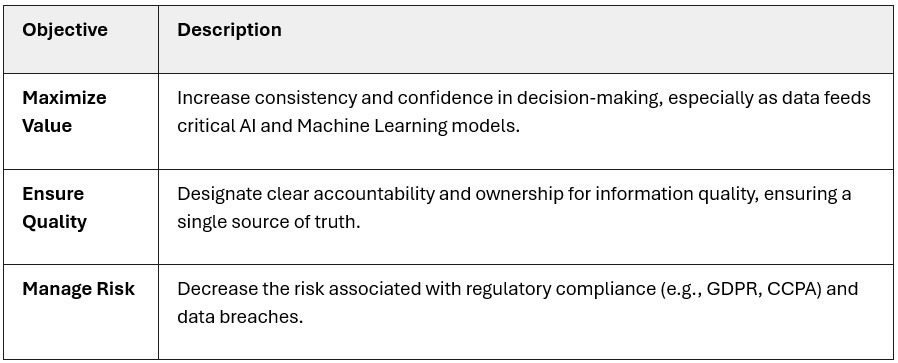
In simple terms, Data Governance is the strategic discipline of establishing how an organisation gets its data right, keeps it right, and takes full advantage of it.
A robust Data Governance framework systematically combines people, processes, and technology to ensure the consistent, proper and secure handling of an organisation’s data across the entire enterprise.
The Clear Signs of Ungoverned Data
An enterprise without a formal Data Governance program often struggles with fundamental issues that hamstring digital transformation:
• No Clear Data Ownership: Key data domains (e.g. customer, product, supplier) have no assigned owners (Data Stewards). This ambiguity leads to people being unsure who to ask for definitive answers, resulting in key business decisions being made with incorrect or outdated information.
• Inconsistent Definitions: Data definitions, terminology, and rules for usage are not formally agreed upon or documented. Consequently, different departments speak different “data languages,” undermining cross-functional analytics.
• Missing Standards and Policies: Without supporting policies and standards, it becomes impossible to inform, measure, and report on the compliance, quality and lineage of data captured in operational systems. This is the difference between wishing for good data and mandating it.
Your Roadmap: How to Start Governing Data Today
Launching a successful Data Governance program does not require an immediate organisational overhaul; it requires strategic, incremental steps focused on high-value data:
1. Establish the Program Foundation:
o Set clear, measurable objectives (e.g., “Reduce customer data errors by 20% in Q3”).
o Form decision-making bodies and define decision rights that align with your organisational culture and staffing.
2. Designate Your Data Experts:
o Designate Data Stewards to serve as the official, go-to data experts for their respective domains (customer, product, finance). They are the crucial link between business strategy and data quality.
3. Know What You Have (The Data Audit):
o Conduct a data audit to discover all existing data sources, assess their current state, and identify how many variants and versions of the same data are currently in use across the company.
4. Define a Structured Onboarding Process:
o Create a formal process for onboarding new data sources. This ensures all new data meets established quality standards and availability criteria before it enters the ecosystem.
5. Build the Infrastructure for Sharing:
o Invest in a data infrastructure (e.g., a modern data platform or fabric) that allows for consolidation and harmonization. This guides users to a shared platform that is guaranteed to be current and accurate, replacing siloed data lakes.
Conclusion: Turn Opinion into Insight
Data Governance is not a regulatory burden; it is the invisible foundation that ensures your organisation’s most valuable asset – your data – is reliable, compliant and ready to fuel your next wave of innovation. By establishing a framework of people, process and technology, you move beyond mere opinion and create a durable competitive advantage built on trusted, high-quality data.
About the Author:
Priyanka is passionate about solving business problems with technology. With 19 years of international experience across India, Germany, USA & New Zealand, she has helped businesses make better decisions and improve performance by unleashing the power of their data with Data Analytics and AI.
Her journey so far has taken her from helping C-suite execs and senior stakeholders in public and private sector organisations in designing their Data Strategies, Data Management, and Data Governance practices. Along the way, she has led, built, and mentored teams to design and deliver Data and AI solutions.
See Priyanka’s profile here.